
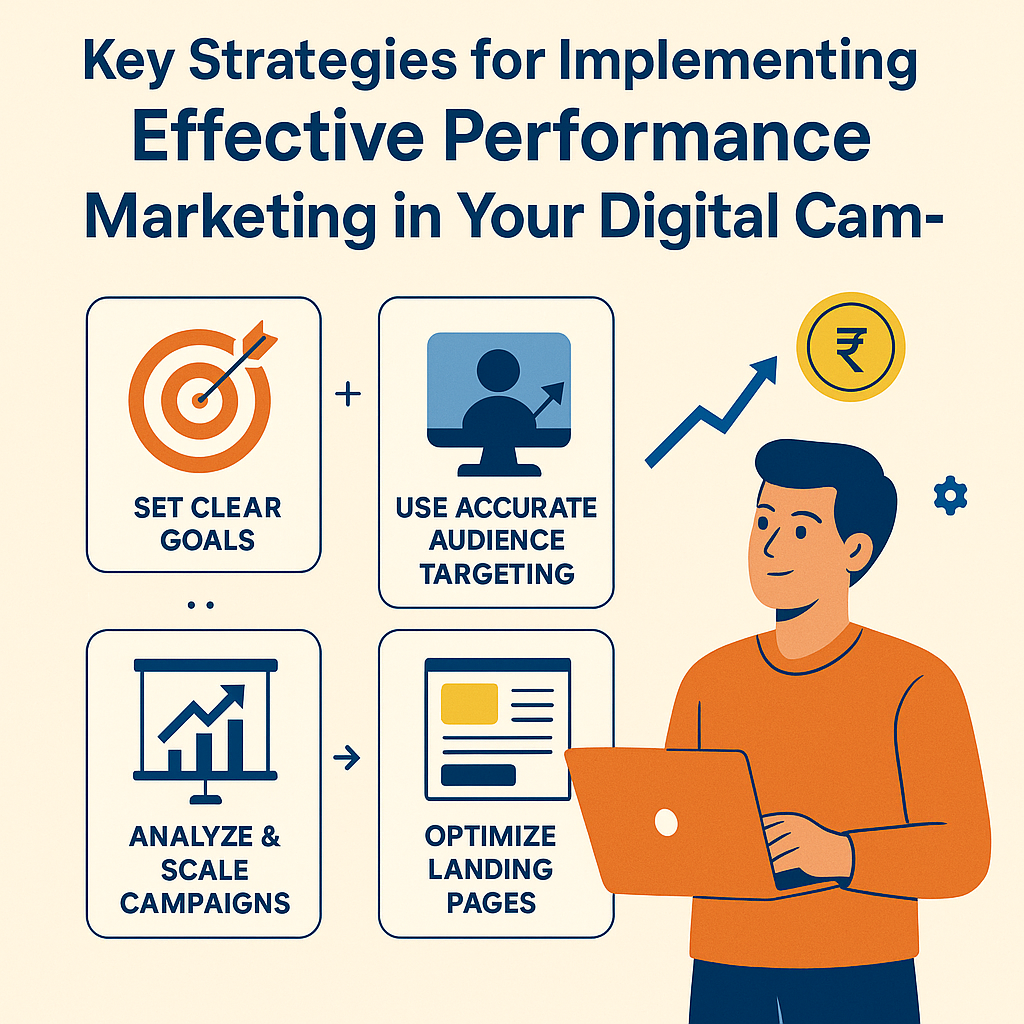
Key Strategies for Implementing Effective Performance Marketing in Your Digital Campaigns
In today’s competitive digital landscape, brands no longer invest in marketing simply for visibility—they invest for measurable results. That’s where performance marketing comes in. Whether you’re running ads on Meta, Google, YouTube, or any other platform, performance marketing ensures every rupee spent works towards a specific outcome—be it leads, sales, downloads, or website actions.
If you want to scale your brand efficiently, adopting the right performance marketing strategies is crucial. In this blog, we’ll explore the key strategies for implementing effective performance marketing in your digital campaigns, along with practical insights that digital marketers and business owners can immediately apply.
1. Start With Clear, Measurable Goals
Every successful performance campaign begins with well-defined goals. Without clarity, you can’t measure progress or optimize your ads.
How to Set Effective Goals:
Use the SMART method (Specific, Measurable, Achievable, Relevant, Time-bound)
Align campaign goals with the customer journey
Choose performance metrics that directly support revenue
Examples of Strong Performance Goals:
Reduce cost per lead by 20% within 30 days
Achieve a 4% CTR on search campaigns
Generate 500 qualified leads per month
When your goals are measurable, your optimization becomes easier and your results become more predictable.
2. Choose the Right Channels for Your Audience
Performance marketing works best when your campaigns are running on platforms where your customers already spend time.
Key Channels for Performance Marketing:
Google Ads: Best for high-intent keyword searches
Meta Ads (Facebook + Instagram): Ideal for interest-based targeting & retargeting
YouTube Ads: Great for awareness + performance hybrid goals
LinkedIn Ads: Strong choice for B2B lead generation
Affiliate Marketing: Effective for scaling without upfront cost
Every channel plays a unique role. For example, Google brings ready-to-convert audiences while Meta builds desire and demand. A balanced mix ensures high ROI.
3. Use Accurate Audience Targeting
Targeting is the heart of performance marketing. Poor targeting leads to wasted budget, while precise targeting increases campaign efficiency.
Targeting Strategies That Work:
Custom Audiences: Website visitors, lead forms, video viewers
Lookalike Audiences: Target people similar to your best customers
Behavioral Targeting: Interests, device usage, shopping behavior
Keyword Targeting: Use transactional keywords like “buy,” “near me,” “best,” etc.
Why Accurate Targeting Matters:
It helps you reach people who are already interested, reducing customer acquisition cost (CAC) and improving conversion rates.
4. Create High-Converting Ad Creatives
Your ad creative determines whether a user clicks or scrolls past. In performance marketing, the right creative can improve campaign results by 30–60%.
Elements of High-Performance Creatives:
Clear headline that states the benefit
Strong visuals that capture attention
Emotional triggers that resonate with users
Short, persuasive copy with a strong CTA
Brand consistency across all platforms
Creative Formats That Perform Well:
UGC-style videos
Short videos (6–15 seconds)
Carousel ads
Before/after creatives
Testimonials
Refreshing creatives every 15–30 days maintains performance and fights ad fatigue.
5. A/B Test Everything—Consistently
No matter how experienced a marketer is, guessing never beats testing. A/B testing helps you understand what genuinely works for your audience.
What to A/B Test:
Ad copy
Creatives
Headlines
CTA buttons
Landing page layouts
Targeting combinations
Placements
Even small changes—like a new headline or CTA—can significantly increase conversions.
6. Optimize Your Landing Pages for Conversions
Sending traffic to a poorly optimized landing page wastes your budget. Your landing page must be fast, convincing, and action-oriented.
Landing Page Optimization Best Practices:
Keep your design clean and mobile-friendly
Use a clear USP and value proposition
Place important info above the fold
Add social proof (reviews, ratings, testimonials)
Use fewer form fields for better conversion
Add urgency triggers like “limited time offer”
A high-quality landing page alone can improve your conversion rate by 20–40%.
7. Use Pixel Tracking and Analytics Properly
Performance marketing relies on data. Without proper tracking, you cannot measure or scale your campaign.
Tools You Must Use:
Meta Pixel
Google Tag Manager
Google Analytics 4 (GA4)
Server-Side Tracking (for advanced attribution)
UTM parameters to track ad performance
Correct tracking ensures you make decisions based on facts, not assumptions.
8. Retargeting – The Secret to Lower CAC
Most users don’t convert in the first interaction. Retargeting brings them back and significantly increases your conversions.
Powerful Retargeting Audience Pools:
Website visitors (7, 14, 30 days)
Add to cart but did not purchase
Form opened but not submitted
Video viewers (50%, 75%)
Instagram engagers
Retargeting drastically lowers cost per result and boosts ROI.
9. Implement Conversion Rate Optimization (CRO)
Performance marketing is not just about getting clicks but ensuring users complete the intended action.
CRO Techniques That Boost Conversions:
Short forms
Intelligent pop-ups
Heatmaps to understand user behavior
Simplified checkout experience
Trust badges
Sticky CTA buttons
Continuous CRO improves your cost per sale and enhances user trust.
10. Analyze & Scale Winning Campaigns
Scaling is the final step—but it requires a strategic approach. You can’t simply “increase the budget and expect magic.” You must scale smart.
Ways to Scale Campaigns:
Gradually increase budget by 10–20% every 48–72 hours
Duplicate winning ad sets
Expand into new interest groups
Increase daily budget for top-performing campaigns
Scale horizontally across similar audience sets
Expand winning creatives into new formats
If you scale too fast, your ads may enter the learning phase again and disrupt performance. Smart scaling ensures sustainable growth.
11. Monitor KPIs That Actually Matter
Don’t get distracted by vanity metrics. Focus on KPIs that directly impact performance.
Important KPIs in Performance Marketing:
Cost Per Lead (CPL)
Cost Per Acquisition (CPA)
Return on Ad Spend (ROAS)
Click-Through Rate (CTR)
Conversion Rate (CVR)
Customer Lifetime Value (LTV)
Tracking the right metrics allows smarter decisions and stronger returns.
Final Thoughts
Performance marketing is one of the most powerful tools for businesses wanting measurable, scalable results. By following the right strategies—clear goals, precise targeting, strong creatives, continuous testing, optimized landing pages, and data-driven scaling—you can turn your digital campaigns into consistent revenue generators.
Whether you’re a startup, local business, or established brand, implementing these key strategies will help you run more profitable, efficient, and conversion-focused campaigns.
If you need help building or optimizing performance marketing campaigns, feel free to ask—I’d be happy to assist!